When Should You Start Your Diwali Marketing?
The short answer
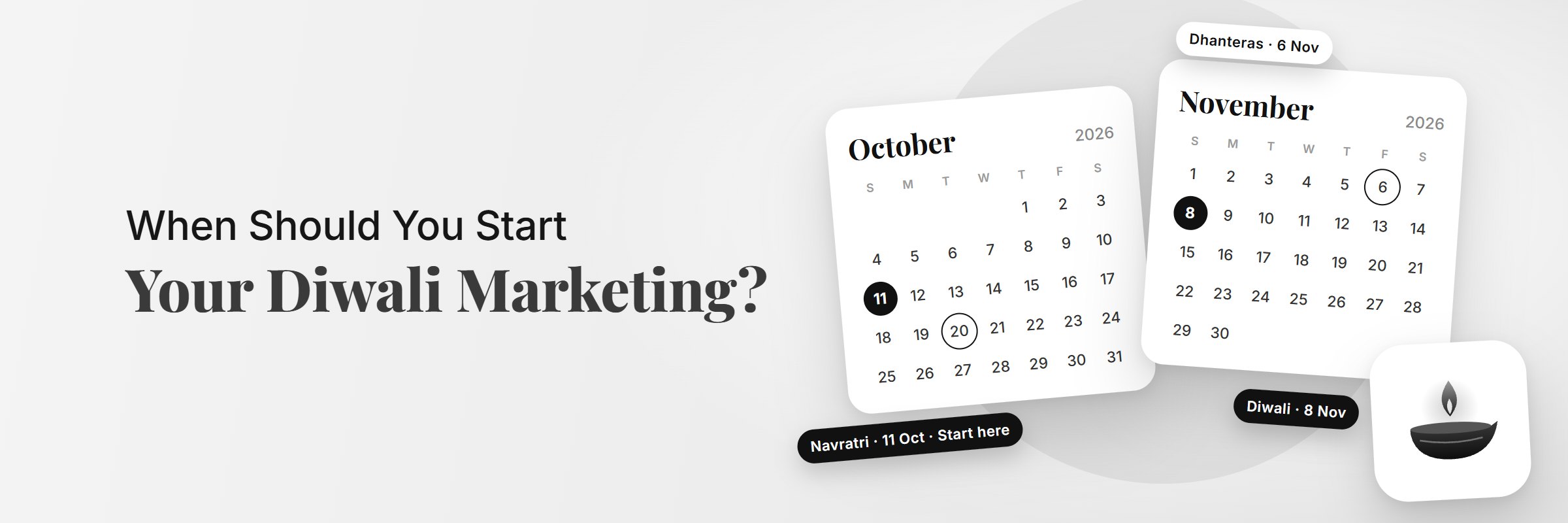
Start planning about two months before Diwali, and have your festive creatives shot and approved before Navratri begins. People decide what they are buying well before Diwali, and in many categories they buy on Navratri or Dhanteras, not on Diwali night. In 2026, Diwali is on 8 November and Navratri begins on 11 October, so planning belongs in the first half of September.
Most festive campaigns start in the middle of October. Someone decides the brand needs a Diwali campaign: a reel, some posts, maybe ads, live as soon as possible. By then, most of the people it's meant to reach have already decided what they're buying.
Diwali is the day everyone plans for, and it's usually the least useful day to be posting about it. Here's how the timing actually works, and how we plan it.
When should you start your Diwali marketing?
About two months before Diwali for planning, and around Navratri for posting. Your festive creatives should be shot and approved before Navratri begins, so the whole month between Navratri and Diwali is spent publishing, not producing.
For 2026 that works out to:
- First half of September: decide the idea, the offer and the budget.
- Late September: shoot and edit, then get everything approved.
- From 11 October (Navratri): start posting.
- 6 November (Dhanteras): the strongest buying push.
- 8 November (Diwali): the greeting, and the end of the push.
If that already sounds late for this year, skip to what to do if you're starting in October.
What are the festive dates for 2026?
| Festival | 2026 date | What it means for brands |
|---|---|---|
| Navratri begins | Sunday, 11 October | The season opens. Many families buy cars, gold and homes during these nine days |
| Dussehra | Tuesday, 20 October | Considered an auspicious day for buying vehicles and starting new things |
| Dhanteras | Friday, 6 November | The traditional day for buying gold, silver, utensils and vehicles |
| Diwali (Lakshmi Puja) | Sunday, 8 November | Greetings and gifting. Most of the purchasing has already happened |
Festival dates follow the lunar calendar, so they move every year. Some regions also observe certain festivals a day apart. Check the panchang for your market before you lock a calendar.
Why do people buy before Diwali instead of on it?
Because in India, when you buy something matters almost as much as what you buy. A car, a piece of gold or a new home is meant to arrive on an auspicious day, and Navratri, Dussehra and Dhanteras are those days for a lot of families. Diwali itself is for puja, family and sweets. Nobody's spending Lakshmi Puja evening comparing loan offers.
So a purchase that happens on Dhanteras was decided earlier. Before that day, someone visited showrooms, asked a cousin, checked prices on their phone and talked it over at dinner. That's the window your brand needs to be in. A beautiful post on Diwali morning reaches them after the decision is made.
Gifting runs on the same logic. Companies place corporate gift orders weeks in advance, and families buy gifts in time to hand them over. A gifting brand that starts in Diwali week is mostly selling to people who forgot.
What does the timeline look like, week by week?
This is roughly the plan we work to. The weeks count back from Diwali.
| When | What happens | 2026 dates |
|---|---|---|
| 8–9 weeks before | Pick the idea, the offer and which festivals you'll show up for | First half of September |
| 6–7 weeks before | Script, shoot and edit. Book printers and vendors if you need anything physical | Mid to late September |
| 5 weeks before | Get every creative approved. Set up ads and allow time for ad review | End of September |
| 4 weeks before | Navratri. Start posting, and let people get used to the idea | From 11 October |
| 2–3 weeks before | Run the main push. Ads go behind whatever has already worked organically | Late October |
| Dhanteras week | Purchase reminders, stock, delivery cut-offs, store timings | 2–6 November |
| Diwali | The greeting. Thank the people who bought | 8 November |
| After Diwali | Deliveries, unboxings, thank-you content | From 9 November |
The step people skip is the approval week. Festive creatives go round more times than anything else all year, because everyone in the business has an opinion about Diwali. Plan for that and it won't eat into your posting time.
What should festive creatives actually say?
Pick one idea and carry it across every festival. Don't make a fresh campaign for each one.
Most brands treat every festival as a separate brief. A Ganesh Chaturthi post, a Navratri post and a Diwali post, each with a different look and a different message, all connected only by the logo. Each post might be fine on its own, but nobody remembers what the brand was saying.
We did the opposite for 360 AutoFin. 360 AutoFin arranges car loans and finds the exact car a buyer wants, even when it's sitting in another city. So every festive piece said the same thing: the car you want, from whichever city it's in.
- Ganesh Chaturthi: Bappa comes home, and so does the new car, whichever city it's in.
- Navratri: City badlo, choice nahi. Change the city, not the car you wanted. It's spoken straight to camera, in the Hinglish their buyers actually use.
- The festive season ad: any car, any city, one number to call, before the rush starts.
Three festivals and three different pieces of content, but they all say one thing, and that one thing is what the business sells. The festival is the reason to post. The message is still the brand's.
Greeting posts or selling posts?
You need both, but they do different jobs, and most brands get the balance wrong.
| Greeting post | Selling post | |
|---|---|---|
| Its job | Show you're part of the occasion | Get someone to act before the festival |
| When it works | On the day itself | In the weeks before |
| What it needs | Taste, and something that doesn't look like every other brand's | An offer, a deadline, and a clear next step |
| The usual mistake | A stock diya and "Wishing you a prosperous Diwali" | Putting it out on Diwali morning, after people have already bought |
If a greeting post is the only festive content you make, you've done the part that sells the least.
What goes wrong when brands start late?
Most of it is predictable:
- The shoot gets rushed. Photographers, studios and editors get booked up fast in festive weeks, and a rushed shoot always looks rushed.
- Ads go live without being tested. There's no time to find out what works organically first, so money goes behind a guess, and in the weeks when ads cost the most.
- Printers say no. Anything physical, like hampers, packaging sleeves, standees or event collateral, needs a printer, and festive season is the printers' busiest time too.
- Delivery cut-offs get missed. An e-commerce brand that promotes gifting in Diwali week has to explain why the gift won't arrive until after Diwali.
- Everything looks the same. When there's no time to think, everyone reaches for the same diyas, rangoli and gold gradients, and the feed turns into one long greeting card.
Already October? What to do if you're starting late
If you're reading this in October, you can still do something useful. You just have to do less, and do it sooner.
- Pick one offer. A single clear reason to buy now beats five half-explained ones.
- Make one strong reel and a few stories. Build it around the offer, not around the festival.
- Tell the people who already know you first. Existing customers, your WhatsApp list and past buyers. They need the least convincing and they're the cheapest to reach.
- Aim at Dhanteras, not Diwali. Push hardest in the days before 6 November.
- Put ads behind the post that's already working. Don't use your ad budget to test.
- Put your delivery cut-off and store timings everywhere. In the bio, in stories, in captions. It answers the question people would otherwise DM you about.
What you shouldn't do is try to squeeze a full two-month plan into three weeks. It never fits, and the quality drops everywhere.
A checklist for next year
Diwali comes back every year, so the plan can too. Save this and start it around the middle of August:
- Look up next year's dates. Navratri, Dussehra, Dhanteras and Diwali, for your region.
- Choose one idea that connects the festivals to what you actually sell.
- Lock the offer and the budget two months out.
- Book the shoot and any printers before September gets busy.
- Leave a full week for approvals.
- Start posting at Navratri.
- Push hardest before Dhanteras.
- Keep the Diwali greeting simple, and make it look like you rather than every other brand.
If you'd like help planning yours, have a look at how we build content and social systems and run performance marketing, or start a conversation with us early. Ideally that's before Navratri.