Why Has My Instagram Reach Dropped, and What Actually Brings It Back?
The short answer
Instagram reach usually drops for an ordinary reason: what you post has changed, who follows you has changed, the platform has started favouring something you do not make, or Insights is measuring it differently. A true restriction is rarer than people assume, and you can check for it in Account Status. Split your reach into followers and non-followers first. That tells you which problem you have.
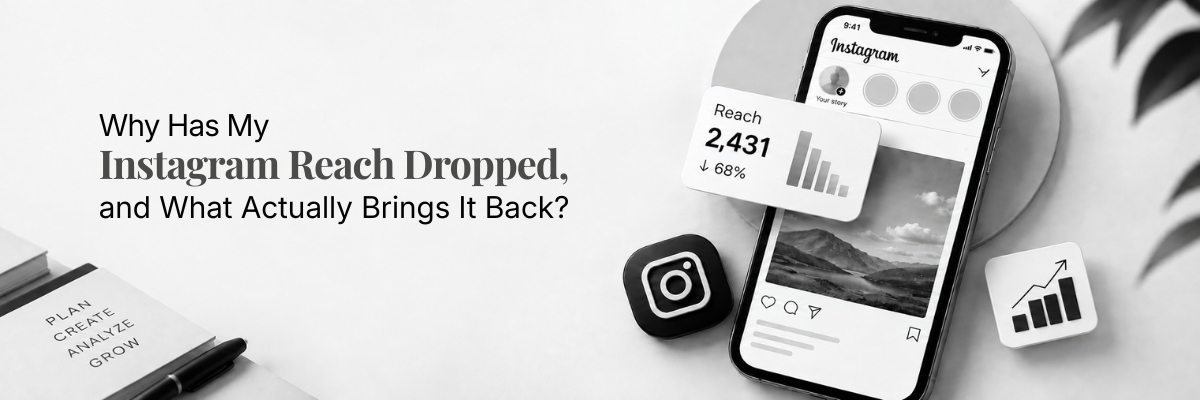
It usually starts with one post. You put up something you were quite pleased with, check back that evening, and it has done a fraction of what the last few did. Then the next one does the same. By the third, somebody on the team has said the word shadowban, and a lot of time gets spent looking for a switch that someone at Instagram flipped.
Occasionally there is one. Most of the time there isn't, and the real reason is more boring and a lot more fixable.
Is my Instagram account shadowbanned?
Probably not. Instagram doesn't use the word, but it can stop an account's content being recommended to people who don't already follow it. You can check that directly instead of guessing: search for Account Status in your settings, and it will tell you whether your content is currently eligible to be recommended.
If Account Status is clear, stop looking for a ban. Nobody is punishing the account. The content is being shown to people and they aren't responding to it the way they used to, and that is the problem to work on.
If it isn't clear, that is genuinely useful to know. It usually points to specific posts that broke the recommendation guidelines, and those are worth dealing with before anything else in this article.
What actually causes Instagram reach to drop?
Nearly every drop comes down to one of four things.
The content changed. Different formats, a different tone, a new person running the account, more promotional posts crowding out the useful ones. Often nobody decided to change anything. It just drifted over a few months.
The audience changed. A giveaway, a collaboration or one post that went viral brought in lots of people who followed for that one moment and have no real interest in what you usually post. Every later post now goes out to a bigger audience that cares less, and the numbers show it.
The platform changed what it favours. Instagram doesn't run one algorithm. Feed, Stories, Reels and Explore are each ranked separately, and what each one rewards shifts over time. Instagram has said publicly that it favours original content over reposts, and that content carrying another app's watermark is less likely to be recommended. An account built on either of those will feel the change.
The measurement changed. This one catches people out. Instagram has renamed and redefined the headline numbers in Insights more than once, so a comparison against last year isn't always comparing the same thing. Before you conclude reach fell, check that the number you're looking at meant the same thing in both periods.
How do you work out which one you have?
Open Insights and split reach into followers and non-followers. That one view does most of the diagnosis for you.
- Non-follower reach collapsed, follower reach is steady. Your posts have stopped being recommended to new people. Check Account Status, then look at originality and at how the first second or two of your reels holds a stranger.
- Follower reach fell too. Your own audience is engaging less. Either the content has drifted from what they followed you for, or a chunk of your followers were never really interested in the first place.
- Both look normal, but the total fell. Compare the formats. A drop in reels volume or a switch from carousels to single images will show up as lower reach overall even when each format is performing fine on its own terms.
Two rules make this honest. Compare like with like — a carousel against earlier carousels, not against a reel that took off. And compare equivalent periods, because a festive month and the quiet month after it are never going to look the same.
Reels, carousels, stories and single images, compared
These are not interchangeable, and a lot of reach problems are really format problems.
| Format | What it does best | Who mostly sees it | The usual mistake |
|---|---|---|---|
| Reels | Reaching people who don't follow you yet | Largely non-followers, when it's recommended | A slow opening, or a clip reposted from another app |
| Carousels | Getting saved and shared | Followers, then wider when people engage | Cramming ten slides with what should have been three |
| Stories | Keeping existing followers close | Almost entirely followers | Using them for announcements nobody asked for |
| Single images | Holding the look of the grid together | Mostly followers | Expecting them to bring in new people |
A healthy account uses these for different jobs. An account that went all-in on one format usually has a reach problem that looks mysterious until you notice every post is trying to do the same thing.
Why did one viral post make things worse?
Because it changed who you are posting to.
A post that travels a long way brings in followers who liked that post, not your account. If the next ten posts are nothing like it, most of those new followers ignore them. Instagram sees more people shown each post and a smaller share of them responding, and it adjusts how widely it pushes what you make.
This is also why bought followers and broad giveaways backfire. You end up with a larger audience that was never going to engage, and you pay for that audience on every post after.
None of this means going viral is bad. It means the follow-up matters more than the post. If something takes off, the useful move is to work out what people responded to and make more of that, rather than going straight back to the usual schedule.
What quietly kills reach
A handful of habits do more damage than any algorithm change:
- Reposting clips with another platform's watermark still on them. Instagram has been clear it recommends these less. Export the original file instead.
- Deleting and reposting posts that underperformed. It rarely changes anything and it makes your own Insights useless for working out what went wrong.
- Posting what the business wants to say, rather than what anyone would want to receive. A launch announcement is important to you. It is not something a follower sends to a friend.
- Chasing every trend. A trending audio on a post with nothing to do with your brand might get a few views from strangers, but they won't follow you. Where it's off-brand, it also confuses the people who already do.
- Posting more to make up for it. More underperforming posts don't add up to reach. They add up to a longer record of posts people scrolled past.
What actually brings reach back?
Nothing clever, which is why it tends to get skipped.
Make things people would send to someone. Instagram has said publicly that shares, and especially posts sent in private messages, weigh heavily in deciding what reaches people who don't follow you. So the useful question for any post isn't whether it looks good. It's who would forward this, and to whom. If nobody comes to mind, it's a follower post at best.
Earn the first second of every reel. Someone who doesn't know you gives a reel almost no time before scrolling on. Open on the problem, the result or the most interesting frame. Save the logo and the introduction for the end, or leave them out.
Test before you commit. Professional accounts can post Trial Reels, which are shown to non-followers first without appearing to your followers. It's the cheapest way to find out whether a new format holds strangers before you put it on the grid.
Build a recognisable format rather than a stream of posts. An account people can recognise without reading the name gets engagement that one-off posts don't, because followers know what they're getting and look out for it.
Pick a rhythm you can keep up. A steady, sustainable schedule beats a burst of daily posting that stops in three weeks. The gaps after a burst do more damage than posting less often ever would.
How this looks on real work
Nail Daze sells press-on nail sets designed like editorial objects, and its feed was art-directed as one nine-tile composition: tiles alternate hand, product and editorial, with the mark holding the centre. Anyone landing on that profile knows within a glance what the brand is, which is a big part of what turns a stranger into a follower.
Cyber Shoppe sells network infrastructure, security, backup and surveillance, which is about as hard a subject for Instagram as there is. So each tile opens on a problem an IT head has actually had at two in the morning, then answers it. Somebody who has had that problem forwards it to someone else who has too, and that's exactly the kind of share that reaches new people.
NexArtha is a CA-led advisory firm, and its feed teaches before it sells: what the name means, what the firm does, who is behind it. In professional services, useful content is what gets saved and passed along, and the pitch can wait.
Three very different businesses, but the grid was treated as a system in all three, and none of them was built around waiting to see what the algorithm would reward.
What to check this week
In order, and none of it takes long:
- Account Status. Rule out a recommendation restriction before anything else.
- Followers vs non-followers. Find out which reach dropped.
- Format mix. Compare the last month's formats against a month when reach was healthy.
- Your last ten posts. For each one, honestly: would anyone send this to a friend?
- Where recent followers came from. A giveaway or a one-off viral post explains a lot.
- Watermarks and reposts. Remove the habit, not just the posts.
- Your schedule. Pick a rhythm you'll still be keeping up in three months.
One last thing worth keeping in mind. Whatever you build on Instagram sits on a platform that can change its rules whenever it likes, which is the argument for owning a website alongside it. Treat reach as something you earn post by post, and keep somewhere of your own for the people it brings in.
If you'd like a second pair of eyes on your account, you can see how we approach content and social systems, or start a conversation about what's going on with yours.