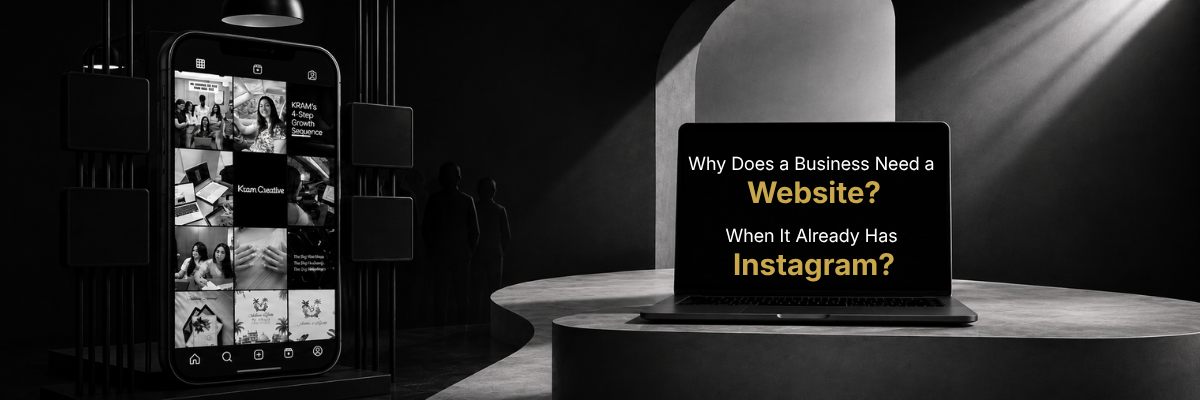
Why Does a Business Need a Website When It Already Has Instagram?
The short answer
A business needs a website because it is the only place online it owns outright. A social profile is space rented from a platform that sets the rules, decides the reach and can restrict the account without warning. A website is also the surface Google and AI answer engines read when someone asks about your business, and it is where a visitor who is ready to buy can act without waiting for a reply.
Plenty of businesses run for years without a website. The orders come through Instagram, the enquiries come through WhatsApp, the referrals come through people who already know them. It works, so the website keeps getting postponed, and the postponement never causes a visible problem.
That is the difficulty with this question. The cost of not having a website is real, but it is invisible, because it is made entirely of things that quietly did not happen.
What does a website do that social media cannot?
It belongs to you. Everything else you publish on sits on land you are renting from a company whose interests are not yours, and which can change the terms whenever it likes.
That is not a hypothetical risk. Reach on a social platform is set by the platform, not by you. The rules for what can be posted, sold or advertised change without consultation. Accounts get restricted, occasionally in error, and the appeal process is a form. None of that has an equivalent on a domain you own, where you decide what is published, how it looks, and who can reach it.
There is a second difference that matters just as much. A feed is chronological, so it shows what you did recently. It is very poor at showing what you sell, who it is for, what happens after someone enquires, or why you should be trusted — because all of that is fixed information, and a feed is built to bury fixed information under new information.
Is Instagram enough if that is where my customers are?
Instagram is where people find you. It is rarely where they decide.
The sequence for most considered purchases now runs: see something on social, look the business up properly, then buy. The looking-up step is where a website earns its place. Somebody at that stage has questions a feed answers badly — what exactly do you sell, do you deliver here, what does it cost to start, who is behind this, has anyone else used them — and if there is nowhere to go and check, a good number of them stop there rather than sending a message and waiting.
Social and a website are not competing. Social creates the interest; the website converts it. A business running only on social is doing the expensive half of the work and then handing the outcome to whoever the customer finds next.
Website vs social profile, compared
| Social profile | Website | |
|---|---|---|
| Who controls it | The platform | You |
| What happens if the account is restricted | You lose the audience and the archive | Nothing |
| What it is good at | Discovery, personality, momentum | Explanation, proof, conversion |
| Fixed information | Buried under the newest post | Where you put it, permanently |
| Readable by Google and AI answer engines | Largely not | Yes |
| What a ready buyer can do | Send a message and wait | Buy, book or call now |
| What it costs over time | Constant content, forever | Built once, maintained |
Neither column is the better one. They do different jobs, and the second job does not get done by doing more of the first.
Does a website help people find you on Google and AI search?
Yes, and this is the part that has changed most recently. Search engines have always built their understanding of a business from pages they can read. AI answer engines now do the same thing, and they are increasingly what people use when they ask for a recommendation.
When somebody asks an assistant for a good supplier of what you sell, the answer is assembled from sources that could be read: your own pages, directories, articles that mention you. A business whose entire presence is a social account is largely absent from that process, because most of what it has published is inside an app rather than on the open web. Being unfindable there is a new problem, and it will get larger rather than smaller.
Your own site is also the only place where you control the description of your business that these systems read. Everywhere else, someone else wrote it.
When does a business genuinely not need a website?
Worth saying plainly, because the answer is not never.
A business does not need one yet when it sells to a small circle who already know it, when everything runs through one channel that is working, or when the idea itself is still being tested and might change next month. A stall, a single-chair salon with a full book, a service sold entirely through referral — none of these is being held back by the absence of a site.
The threshold is strangers. The moment your buyers include people who have never met you, and who will look you up before deciding, a website stops being a nice-to-have. It becomes the thing doing the reassuring while you are asleep.
What should a first website actually contain?
Less than most people are sold, and it should be built around one job rather than a page count.
The job comes first: the single thing the site exists to produce — an enquiry, a call, a booking, an order. Then, on the first screen, what the business does in language a stranger understands. Then what you sell and who it is for. Then proof, meaning real work, real clients or real credentials rather than adjectives. Then a route to a human that is visible from wherever the visitor happens to be. And enough plain information about the business — where it is, who runs it, how to reach it — for both a person and a machine to conclude that you are real.
Everything beyond that is decided by what the business actually needs, not by a template.
How this looks on real work
360 AutoFin is a car finance business. The job of that site was getting a visitor from "can I trust these people" to a phone call, so five pages were built around it with the route to a human never leaving the screen. Most of that audience arrives on a phone, so that is the width the layout was decided at first. In finance, the site is not decoration. It is the part that makes a stranger willing to ring.
NexArtha is a CA-led advisory firm founded by five chartered accountants. Advisory work is won in rooms — a networking evening, a lobby, a conversation — and the site is what the person does next, after the room. It was built on ruled lines and a strict grid because structure is what the firm is actually selling, across seven pages, with the India–UAE desk given a page of its own rather than a line in a list.
Different businesses, same principle. Neither site began with a page count. Both began with a sentence about what the site had to do.
What to settle before you commission one
Five things, agreed before anybody opens a design file:
- What one job the site has to do, and how you will know whether it is doing it.
- Who owns the domain, the hosting and the source files. Settle it now, not at handover.
- Who can update it after launch, and without whose help. A site nobody in the business can edit goes stale no matter how well it launched.
- What is genuinely needed on it, page by page, and what has only been suggested.
- What happens after launch. Launch is when the useful information starts arriving, not when the work ends.
If you are weighing this up, the question is not whether you can survive without a website. Plenty of businesses do. It is whether you are comfortable that every stranger who looks you up is currently forming their opinion somewhere you do not control.
You can see what the build itself covers on web development, read how it sits alongside the rest of the work in The Sequence, or start a conversation about what your business actually needs.